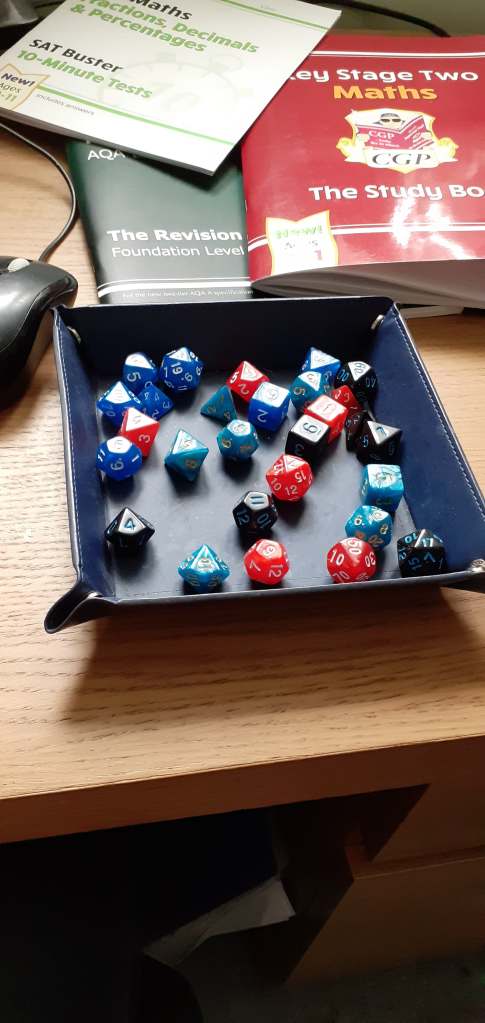
I’m currently planning a lesson, and I needed to have a few questions ready, particularly for quick-fire, mental maths. I needed some numbers and almost instinctively grabbed my Dungeons and Dice.
Then as I was rolling, I realised I had a great tool for learning, staring me in the face. In this set, I have D20, D12, D10, D8, D6 and D4. How much fun would it be for a child not to recite answers from a dull page, but instead roll these dice to get the sum?
You can also adjust the difficulty by changing the dice you roll, and if you roll multiple d10, you can get two, three, four or as many digit numbers as you want.
These are inexpensive from amazon or any other hobby story, and you can get them in pretty much any colour. They are also tactile and keep your kids engaged for longer.
They are a great learning tool. Give it a try and comment below. Let me know how your child takes to it.
What does a tomato have to do with productivity? And how can it help you and your child to stay focused on a task?
As soon as you have finished reading this post and you have liked and shared it, I want you to follow these instructions
Sit down, with the task you have to do and set a timer for 25 minutes. Work only on that task for the duration. Put your phone on silent, get distractions out of the way and close that social media.
When the 25 minutes is over, stop.
Take a break. Some guides suggest five minutes, I say 10. Personally, I find that gives me enough time to boil the kettle, have a look at emails, check social media etc. Bonus points if you can step away from the workspace.
Once your break is done, do another 25 minutes.
Repeat this three more times and then take a long break.
Pomodoro is Italian for Tomato, and this method was given the name by Francesco Cirillo who developed the system as a university student. Cirillo named the system “Pomodoro” after the tomato-shaped timer he used to track his work.
For younger children, you may find that 25 minutes is too long to keep their focus. Feel free to adjust the time to maybe 10 or 15 minutes then allow a break to step away from work for a short while.
Do you know any other productivity hacks? How do you stay focused on a task when its the last thing you want to do. Let me know in the comments below.
This is one of my favourite maths hacks, and when you see how it’s done, you might kick yourself for not noticing it sooner.
I love this hack because it’s a super quick way to build a child’s confidence and teach them the entire nine times table.
Ask your child to write the numbers 0 to 9 all the way down the page.
Then ask them to write the numbers 9 to 0 going down the page right next to them.
Now is the perfect time to point out that they did, in fact, know their nine times table all along, and it is in the correct order.
From here, you can start to introduce questions about the nine times table, and encourage your child to see if they can have a go at answering them with their new “hack”.
If they get really stuck, ask them to write out the two columns of numbers again. This gives them a good anchor in which they can go back to. Kind of like a safe spot before they go out and explore the math mountains again.
There are a few concepts in maths that seem to transcend the subject and manage to find their way into Architecture, Music, literature, and can even be considered art.
The Golden Ratio exists if you split a line into two parts, then take the longer part (a) and divide it by the smaller part (b). You will find that it is equal to the sum of (a) + (b) divided by (A). Which is 1.618.
A step by step is provided at the end of this post 🙂
You can also take a square, multiply one side by 1.618, and you get a rectangle of harmonious proportions: you’re very own Golden Ratio. And this can carry on infinitely.
You can find the Golden Ratio in:
the Pyramids in Giza,
the Parthenon in Athens
Michelangelo’s The Creation of Adam on the ceiling of the Sistine Chapel,
Da Vinci’s Mona Lisa
Even the Pepsi logo follows it.
In nature, a snail’s shell follows the golden ratio, as do many plants. What’s even more interesting, our faces follow the Golden Ratio. Our brains seem to prefer things which support the golden ratio, to such a degree that even the smallest change can make an image appear wrong somehow.
There’s a lot of psychological research looking at if this golden ratio works for faces. Although there is little support for the golden ratio studies have shown that, on average, people rate a synthetic (and therefore entirely symmetrical) face as being more attractive than natural faces. These same studies also show that when there is a marked increase in the distance between the eyes and mouth of a face, it is often considered “grotesque”. Obviously they were talking about me there!
In 2009, further research found Individual Attractiveness is optimized when the face’s vertical distance between the eyes and the mouth is approximately 36% of its length, and the horizontal distance between the eyes is approximately 46% of the face’s width.
However, we have to remember that, like many other studies in psychology, these results are just based on a small sample group whose results have been extrapolated to apply to the general population.
But don’t feel bad if you don’t seem to fit this Golden Ratio, Angelina Jolie doesn’t fit either.
How to find the Golden Ratio
Find the longer segment and label it A
Find the shorter segment and label it B
Take the sum A and B and divide by A
Take A divide by B
If the proportion is in the golden ratio, both will equal approximately 1.618
Like many people in MK, we are getting fibre broadband. Unfortunately, they started work way too early this morning. Naturally, this left me quite grumpy, and I hadn’t even had my cup of coffee. 😂😂😂
However, this has lead me to try my hand at creating custom worksheets, and to see how well my style of teaching translates to an online setting.
What I prefer to do is frame the maths concept around a real-world scenario; which I’ve found makes it much easier for students to grasp, and also has the added benefit of answering the age-old question “what’s the point of this?” What I’d like to do is make maths fun and engaging again; to turn it into something useful that people want to learn, instead of just the textbook exercises people are accustomed to.
Perhaps that’s enough of me just talking at you all at this stage. We really should move on to the worksheet (insert appropriate emoji here).
So, today’s sheet puts the student in the role of assisting a team who are laying cable for Fibre Broadband (guess where my inspiration came from for this). Your task, as their assistant, is to make sure they have enough cable for the job.
Please let me know what you think of this sheet. This is just a mock-up, and I want to see how well notion works for me and any prospective students.

 Tom Sanderson Tutoring